Committee Approves $35,684 In Project Invoices
Madison's Neck River School building committee approved $35,684.54 in closeout invoices and confirmed the town has collected a $2,176,101.21 Inflation Reduction Act tax credit tied to the project.
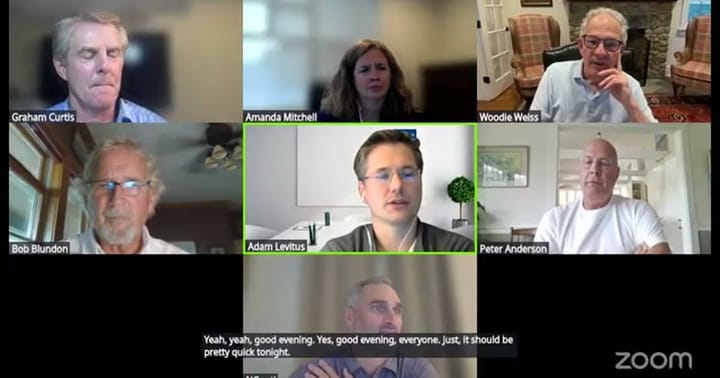
Other Committee · Meeting of August 31, 2026
Madison's Neck River School building committee approved $35,684.54 in closeout invoices and confirmed the town has collected a $2,176,101.21 Inflation Reduction Act tax credit tied to the project. Project team representative Adam called the credit "a resounding success all around" but declined to call the project "under budget," saying instead "the project spent less than the authorized grant amount from the state." A pending Eversource rebate, estimated just under $100,000, remains delayed over an electrical meter calibration dispute. Members said several hundred thousand dollars in subcontractor retention remain unpaid, including amounts held from the mechanical trade.
In remarks, member Graham and a school operations representative identified as Pete discussed ongoing parent complaints over pickup and drop-off congestion, with enrollment "just shy of 700," about 40 students over capacity.
In the full story:
- Who Was There
- Organizations And Documents Referenced
- The complete report — 2,234 words
Source: the Other Committee meeting of August 31, 2026, reported from the official video recording and transcript.
Checked against the record: before publication this article was automatically compared with the meeting transcript.
The Full Article
Approval of Prior Minutes
The committee opened by approving its July 20, 2026 meeting minutes without discussion. A member identified in the transcript as Bob seconded the motion, and it carried on a unanimous voice vote. This was purely procedural and consumed less than a minute of the meeting.
Project Team Update: Tax Credit and Budget Status
Background and stakes: The Neck River School project has been working through a lengthy closeout process, including pursuit of energy-related rebates and tax credits tied to the building's mechanical systems. The committee's recurring "project team update" item tracks that process meeting to meeting.
The question before the body: Members wanted a status check on the project's financial position and schedule as closeout activities continue.
Substantive content: A project team representative identified only as Adam reported that the Inflation Reduction Act tax credit had been received "a couple weeks ago," bringing the town's total recovery to $2,176,101.21 in cash. He described this as "a resounding success all around." A separate Eversource utility rebate, which he estimated at "just under $100,000," remains outstanding while the commissioning team works through a documentation issue: a change made during construction to the type and location of the electrical meters has complicated producing the "typical standard report from the meter manufacturer" confirming calibration accuracy.
The deliberation: A committee member pressed Adam on whether the project could now be called "officially on schedule and under budget." Adam resisted the framing: "That's people's delineations of budget are not something I'm going to weigh in on at this point," he said, offering instead that "the project spent less than the authorized grant amount from the state." The exchange illustrates a recurring caution from the project team about characterizing the financial outcome in terms the state grant program, rather than the committee, controls.
Procedural steps and outcome: No vote was taken on this update item; it was informational.
Implications and what is next: The team indicated continuing email correspondence with the town over the Eversource rebate timeline and metering schedule, with resolution expected over the following weeks.
Landscaping, Punch List, and Site Closeout
Background and stakes: With summer ending, the project team flagged a window to finalize outstanding landscaping decisions before colder weather arrives.
The question before the body: What remains to be decided on landscaping, including the pollinator garden, before the committee can close out that scope of work.
Substantive content: Adam said he planned to set up a two-year site visit with subcontractors including an electrical contractor referred to as "Action Air Electrical" to finalize remaining punch list items. He identified roughly three outstanding landscaping items to resolve with "the landscaper," plus turf installation at the geothermal field and at the southern portion of the play area. A member asked specifically about the pollinator garden, noting that responsibility for it had been split between the contractor, the owner (the town), and a third party, with some plantings not having taken root. Adam noted, with some irony, that unplanted areas near the garden where no weed fabric was installed are now thriving with wind-blown seed growth, while the deliberately planted pollinator garden has struggled.
The deliberation: The discussion was brief and largely confirmatory, with members acknowledging the shared-responsibility arrangement made the landscaping scope "a little gray" and "a little complicated."
Procedural steps and outcome: No formal action; informational only.
Implications and what is next: Email updates on the landscaping resolution plan are expected over the coming weeks, with the committee to remain active on invoice approvals as vendors close out.
Photovoltaic (Solar) System and Capital Planning
Background and stakes: A rooftop or site photovoltaic system was discussed as a potential follow-on project, separate from the core school construction scope, now that project funds and a tax credit have come in.
The question before the body: Where does the solar project stand in the town's capital planning process, and is there a deadline to get it operational for rebate purposes.
Substantive content: A town representative identified as Pete said the plan is to place the solar project into the town's Capital Improvement Plan (CIP) and move forward with it as a standalone project. He said the project is not included in the current fiscal year's capital plan. Discussion touched on whether a rebate incentive tied to the main construction project and a separate solar rebate could both be captured; Pete indicated the town "can't get both," calling the financial comparison between the two incentive paths "a wash."
The deliberation: One member suggested informal advocacy to keep the solar project a priority within the CIP process, telling colleagues "if you want to do a little politicking to make sure it stays in their hearts and minds," referencing unnamed CIP committee members. A reference was made to a person named Laura, described uncertainly as "an alternate," in connection with the CIP committee, though her role and affiliation were not clarified on the record.
Procedural steps and outcome: No vote; the item remains at the planning stage pending future CIP cycles.
Implications and what is next: Timing for the solar project depends on a future capital plan year not yet determined; no date was given.
Mechanical Commissioning and Remaining Punch List
Background and stakes: Functional testing of the HVAC system is a standard closeout requirement before a construction project is considered fully complete.
The question before the body: What remains on the commissioning checklist, and what is the timeline to close it out.
Substantive content: Adam said three commissioning items remain: verifying performance of a dual-temperature coil and the dedicated outdoor air system (DOAS) unit located behind the custodial area, which required specific outdoor temperature conditions now obtained; a measurement-and-verification report expected from engineering firm Salas O'Brien; and calibration verification for the electrical meters tied to the Eversource rebate, complicated by the mid-construction meter change described earlier. Separately, Adam flagged two items that resurfaced since a June warranty walkthrough: a heater inside the enclosure around the firewater break tank, visible from the road as a stainless-looking structure, that is not regulating itself and overheating, though not urgent given current mild weather; and two exterior security cameras that repeatedly go offline for unknown reasons.
The deliberation: The update was delivered without pushback; no member raised concerns about the pace of resolution.
Procedural steps and outcome: No vote taken. Adam said he expects the heater and camera issues resolved "in the next month or two" and the metering documentation "wrapped up over the next week."
Implications and what is next: These are the last listed open items on the mechanical commissioning side; their resolution would move the project closer to full technical closeout independent of the financial retention still held from subcontractors.
Invoice Approval and Construction Contract Retention
Background and stakes: The committee routinely approves invoice packages from the project's remaining vendors as construction and commissioning wind down.
The question before the body: Whether to approve the Aug. 31, 2026 invoice package.
Substantive content: The package included invoices from BVH, the commissioning agent, for completed post-construction and post-occupancy activities; CLA's final invoice, closing out its work on the tax credit; a monthly bill from Colliers; and a bill from Tech Don covering closeout activities. The stated total was $35,684.54, after an initial verbal rounding to "just over $35,000" was corrected on the call.
The deliberation: A member identified as Sharon, who said she had just joined the call, moved to "approve the invoice package dated 8-31-2026, including invoices from BVH, CLA, Colliers and Tech Don for a total approval of $35,684.54." An unidentified member seconded. Following the vote, a member asked whether this concluded Tech Don's billing; the project team said Tech Don "has a little bit of money still in the back end" but is largely finished with post-occupancy services. A further question asked what percentage of the overall construction contract has been paid out; the project team said it did not have the exact percentage on hand but confirmed "several hundred thousand dollars" in retention remains across subcontractors, including the mechanical subcontractor, which remains over its 5 percent retention threshold "just from some of the open items that they had outstanding."
Procedural steps and outcome: Motion by Sharon, seconded by an unidentified member, approved unanimously on a voice vote.
Implications and what is next: The retention figures indicate the project's final cost to the town is not yet fully settled; resolution depends on subcontractors, particularly the mechanical trade, closing out their open items.
Public Comment
No members of the public offered comment at this meeting.
Committee Remarks: Pickup Congestion, Enrollment, and Busing
Background and stakes: Committee members, though focused on construction closeout, have fielded recurring parent complaints about pickup and drop-off traffic at the new school building, a secondary effect of the facility's design and the district's enrollment growth.
The question before the body: Whether the pickup and drop-off situation at the school warrants committee attention or further investigation.
Substantive content: A committee member identified as Graham raised the issue on behalf of parents who had approached him. A school operations representative identified as Pete, also called Peter in the transcript, explained that the site plan approved for the school permits only right turns out of the pickup lot onto Mungertown Road, since a left-turn movement was not authorized. That forces all outbound traffic onto the northbound lane of Mungertown Road, sometimes causing backups, particularly during the roughly ten-minute peak of dismissal before traffic clears by about the fifteen-minute mark. Pete said enrollment, excluding pre-kindergarten, is "just shy of 700," about 40 students above the building's design capacity, and that the share of families driving rather than busing their children has not fallen since rising during the COVID-19 pandemic. He said the district cannot simply redirect more students to buses because state regulation requires every student assigned a bus seat to have one, and the district has not added buses despite enrollment growth.
The deliberation: Members compared the situation to Brown School, which Pete said handles its own pickup and drop-off "pretty well" because of an additional parking lot and a separate pre-kindergarten drive-around lane. They also discussed overlapping dismissal timing with Daniel Hand High School and a middle school referred to in the transcript as "Polson," which Pete said creates roughly a 20-minute delay due to back-to-back release schedules, longer than the delay at the elementary site. One member noted a recent scheduling error that listed a high school bus pickup at 5:30 a.m. on Race Hill Road, which Pete attributed to "a misprint" rather than a policy decision, adding relief that the error occurred at the high school level rather than at an elementary school.
Procedural steps and outcome: No vote was taken; the discussion was informational, with Graham indicating he would look into the matter further to be able to respond to parent inquiries.
Implications and what is next: The pickup and drop-off congestion remains an operational issue outside the committee's direct construction-closeout mandate, but it continues to generate parent complaints that committee members said they are asked about directly.
Adjournment
A member identified as Sharon moved to adjourn; a member identified as Woody seconded. The motion carried on a unanimous voice vote, closing the meeting.
WHO WAS THERE
Committee members participating and voting, roles not confirmed by any supplied roster or agenda: Bob, Sharon, Woody, Graham. Additional voices on the call were not clearly named or may be duplicates of the above.
Project team / vendor representatives: Adam, project team representative (title not specified in available sources); Nick, project team representative (title not specified); Pete, also referred to as Peter, school operations representative (title not specified).
Other names mentioned but not clearly placed as attendees: Laura, referenced as a possible alternate on a capital planning body; George, referenced briefly near adjournment with no stated role.
Public commenters: none; the meeting recorded no public comment.
Outside parties referenced but not present as speakers: representatives of BVH (commissioning agent), Salas O'Brien (engineering firm providing measurement-and-verification reporting), CLA (tax credit consultant), Colliers, and Tech Don (closeout contractor) were discussed but did not speak on the recording.
ORGANIZATIONS AND DOCUMENTS REFERENCED
BVH — commissioning agent for the Neck River School project; invoiced for post-construction and post-occupancy commissioning activities approved in the Aug. 31, 2026 invoice package.
Salas O'Brien — engineering firm providing the measurement-and-verification report cited as one of three remaining commissioning items.
CLA — tax credit consulting firm; submitted a final invoice closing out its work tied to the $2,176,101.21 Inflation Reduction Act tax credit.
Colliers — vendor billed monthly, included in the approved invoice package; role in the project not further specified on the record.
Tech Don — contractor handling project closeout activities; retains some remaining billing for post-occupancy services.
Eversource — utility offering an energy-efficiency rebate, estimated at just under $100,000, still pending due to electrical meter calibration issues.
Action Air Electrical — electrical subcontractor referenced in connection with an upcoming punch-list site visit.
Inflation Reduction Act tax credit — federal tax credit program; cited as the source of the $2,176,101.21 payment received by the town.
Daniel Hand High School and "Polson" (referenced as a middle school) — cited by committee members for comparison on dismissal-time traffic patterns affecting Mungertown Road and Green Hill Road.
Brown School — referenced for comparison on how a different school's site design manages pickup and drop-off congestion.
Share this story
Know someone in Madison who follows town government? Share Townbrief Madison: they can sign up free.