

Conservation panel approves minutes, presses tree fight
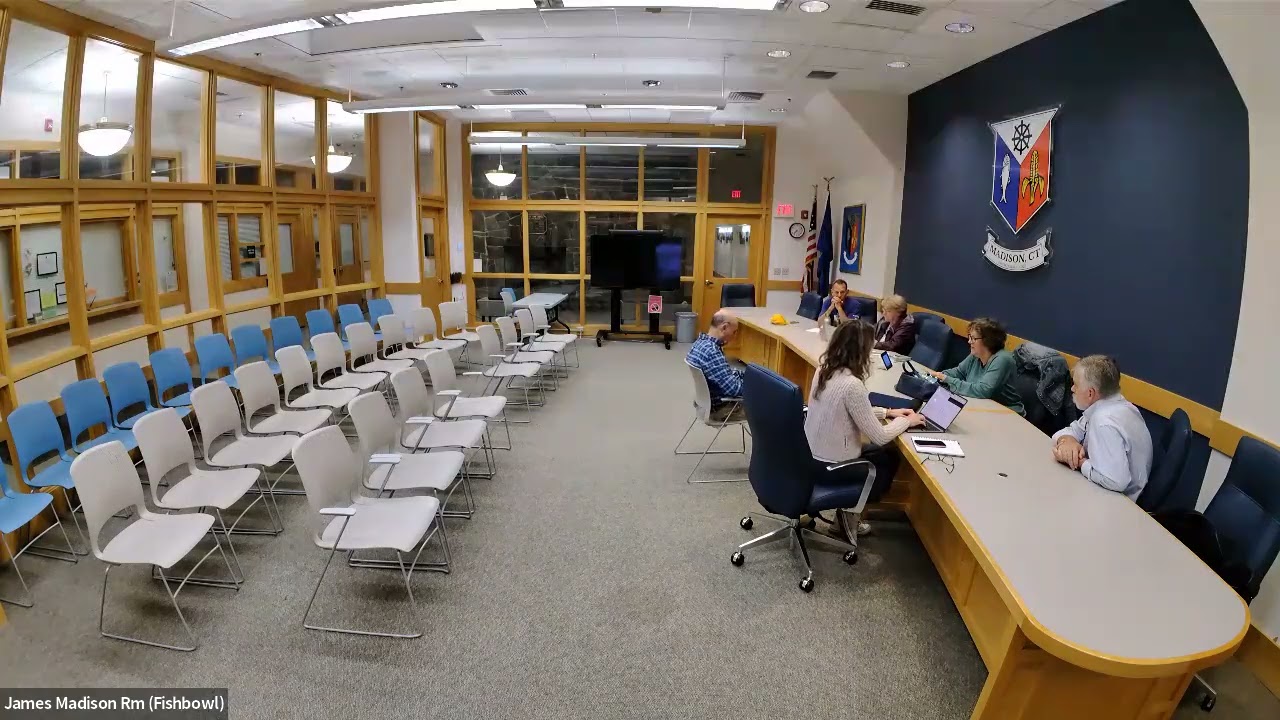
Conservation · Meeting of September 23, 2026
Madison Conservation Commission presses town for tree-of-heaven training and tools. The commission voted unanimously to approve its August 28 minutes and agreed to send the Board of Selectmen a request for staff training, herbicide and time to treat tree of heaven, an invasive species that hosts the spotted lanternfly. Members cited resident Scott Murphy's report of storm-drain damage from the tree's roots as evidence of cost to the town.
They also flagged two new invasive vines, porcelain berry and mile-a-minute, the latter reappearing near Rockland a decade after a large volunteer removal effort, and discussed a bigger Route 79 banner, estimated at roughly $200, to promote rodenticide alternatives ahead of winter. "It has to be pulled, it has to be wrapped up, and it has to be burned," one member said of mile-a-minute vine. The commission also plans tables at the October 17 Bauer Park Festival and the November 6 Madison Land Trust annual meeting.
In the full story:
- Who Was There
- Organizations And Documents Referenced
- The complete report — 2,727 words
Source: the Conservation meeting of September 23, 2026, reported from the official video recording and transcript.
The Full Article
Approval of Minutes and Agenda Changes
The Conservation Commission opened its September 23 meeting, called to order at 7:36 p.m., by approving the minutes of its August 28 meeting. Commission member Terry moved approval; Richard, also called Rich during the discussion, seconded, and the vote passed unanimously. Amy, who has been recording minutes since a recent secretary resignation, reminded the presiding member to add two items back onto the agenda: a rodenticide public-education update and a "materials demonstration" on tree of heaven. No members of the public attended.
Update on the Natural Resource Inventory RFQ
The commission has been waiting on a consultant, referred to in the meeting only as Aaron and described as female, to finalize a request for qualifications (RFQ) for the town's Natural Resource Inventory. A commission member said the consultant had promised since August to update the document's dates so it could be issued, and had repeated that promise "last Monday" and again "this Monday," but had still not delivered it by the meeting date. The item exists because the RFQ has to go out before the town can hire a consultant to complete the inventory; members expressed frustration but took no formal action beyond agreeing to follow up again.
This consultant is distinct from Aaron Rubin, a reporter with the Source newspaper discussed later in the meeting; the meeting audio uses the name "Aaron" for both people.
Intern Projects and Web Content Protocol
Members discussed the status of summer intern projects, including work on light pollution submitted by an intern identified as Jane Constable and sent directly to town staffer Madison Stout (referred to informally as "Maddie") for posting to the town website. Members were uncertain whether the light-pollution content had actually gone live, and agreed to check the town's "Try Our Green Home" or similar page. A second intern project, described as a "deep outline" being prepared by an intern identified only as Caroline, was still pending review.
The discussion led to a broader decision: any commission member wanting content posted to the town website should route it through the full commission first, rather than sending material directly to Stout, "so we don't ever respond to too many different people," a member said. The group agreed the commission should be able to point people to a single link for material such as tree of heaven treatment videos, both from the town's own webpage and from social media, rather than have people search for it.
The Source's Coverage and Joint Land-Use Meetings
Members noted that the Source, Madison's local weekly newspaper, had recently run what one member called a "full page" joint feature on invasive species efforts in Madison and Guilford, describing tree advisor Heather Crawford as "famous again" for being included. The reporter, later identified as Aaron Rubin, had contacted a commission member after a Board of Selectmen meeting seeking additional material, and the piece reportedly ran in the prior week's edition, with a companion piece in the Guilford Courier.
Members also discussed a joint meeting of Madison's land-use commissions, scheduled for the evening after this meeting at 5 p.m. at the Surf Club, intended to let members of different boards discuss how their regulatory roles overlap. Separately, members corrected an earlier note that a September 28 meeting was a Planning and Zoning regulation session; that meeting is instead October 1, beginning with a 6 p.m. session with an outside land-use consultant followed by the Planning and Zoning Commission's regular 7 p.m. meeting. Several commission members said they planned to attend to reiterate the commission's interest in the town's regulation-rewrite process.
Tree of Heaven and Spotted Lanternfly Management
Background and stakes: Tree of heaven is an invasive tree that serves as the primary host for the spotted lanternfly, an invasive insect. The commission has been running a public-signage and education campaign warning residents not to cut the tree without first treating it with herbicide, since cutting alone causes the tree to send up new root sprouts and worsens the infestation. The item traces to a presentation a commission member gave earlier in the week, described in the meeting as being delivered "Monday night," at which fellow commission member Richard asked what would happen if the town did nothing.
The question before the body: What should the commission ask town government to do about tree of heaven and lanternfly management on public property, given limited town action so far.
Substantive content: The commission's roadside signs, originally created by a commission member and physically replicated by parks and grounds supervisor Austin, read in part: "Tree of heaven is an invasive tree and primary host for the recent invader, the spotted lanternfly. To successfully eliminate tree of heaven, plants must be treated with an herbicide before any cutting occurs, or the plant will vigorously sprout multiple sucker plants from the root systems, worsening the infestation." Members debated whether the signs are legible enough — one member said "in a society where we are a third grade reading level," the wording may be too complex — and discussed adding QR codes linking to fuller instructions on commission web pages.
Members compared the lanternfly threat to the gypsy moth, now formally called the spongy moth, which caused severe defoliation in Madison in the late 1970s and again in North Madison roughly a decade ago. One member explained that a fungus and a weevil introduced as biological controls appeared to fail for about ten years before a wet season caused a fungal population crash that collapsed the gypsy moth population. Members cautioned that the same "it'll fix itself" assumption should not be applied to the lanternfly, since it feeds on a much broader range of trees.
The deliberation: Members debated who in town government is responsible for treating tree of heaven. Austin was described as supervising the parks and grounds crew responsible for athletic fields and the beach, while Rob Russo, the town's Director of Public Works and town engineer, oversees crews responsible for roadside vegetation. A member initially asked whether Public Works employee Sam DuBrow was "the head of public works," and the group corrected itself, noting DuBrow reports below Russo. Members said Tree Committee member Al Gross had separately been told by DuBrow that DuBrow "didn't know anything about tree of heaven," underscoring the training gap.
One member said the town's inaction is frustrating given the scale of the problem: "I don't want to sound defeatist. But it's almost like, does it make a difference? If little tiny Madison cleans up this place, and this little place, and that little place, the state lets these forests grow." Members agreed the state Department of Transportation only mows state roadside vegetation every three to five years, and discussed contacting Madison's Hartford delegation, state Rep. John-Michael Parker and state Sen. Christine Cohen, since the group agreed local phone calls to the state Department of Transportation were unlikely to be answered. A name transcribed as Boris Lechman was mentioned as the appropriate town-level contact to reach the delegation, rather than the commission approaching legislators directly.
Members also discussed asking the Source for either another editorial feature or a paid half- or full-page advertisement showing residents how to identify tree of heaven, noting the paper has a relatively new executive identified as Lee Howard. Members weighed pitching reporter Aaron Rubin directly against going through Howard, and noted publication lag of about a week means an ad pitched now might not run until late October, near the point when cold weather ends the growing season.
Procedural steps and outcome: No formal vote was taken. Members agreed a commission member would send a short, one-paragraph email — four to five sentences — to staff contact Peggy, copied to the presiding member, asking the town to require training for beach, recreation and public works crews and to provide them time, personal protective equipment and herbicide to treat tree of heaven. Members described the ask as "training, tools and time."
Implications and what is next: The email is intended as a direct follow-up to this week's Board of Selectmen presentation. Its outcome will determine whether Public Works and parks crews receive herbicide training before the current treatment window closes for the season.
New Invasive Vines: Porcelain Berry and Mile-a-Minute
Background and stakes: A commission member reported two additional invasive vines have appeared in Madison. Porcelain berry, an ornamental plant with blue-purple-green polka-dotted berries, was found growing in the dunes at the Surf Club during a recent cleanup, an environment the member said was unexpected for that species. Mile-a-minute vine, named for its rapid growth, reappeared this spring near Rockland roughly ten years after a large volunteer effort pulled an estimated 400 to 600 seedlings from the area; it has also turned up in North Chestnut Hill and in neighboring Killingworth.
The question before the body: Whether and how to warn residents about these newer invasive plants before they spread further.
Substantive content: The member described mile-a-minute as having a triangular leaf, a saucer-shaped structure around its stem, and bright blue berries; the plant is an annual that dies back each winter but leaves a seed bank viable for up to ten years. The commission plans to produce identification one-pagers for both plants, modeled on its tree of heaven materials.
The deliberation: The member recounted discovering mile-a-minute a decade ago after a master gardener intern found it growing around her pool near Rockland; a subsequent "pulling party" involved members of the Conservation Commission, the Land Trust, beach and recreation staff and the Rockland community. The member said a recent personal trip to Long Island turned up the plant in a protected nature preserve as well, reinforcing concern about its spread.
"It has to be pulled. It has to be wrapped up, and it has to be burned, because those berries get out." [01:10:01] — the commission's tree advisor
Procedural steps and outcome: No vote was taken. The commission agreed to prepare public identification materials for both plants and to continue monitoring known locations.
Implications and what is next: Because mile-a-minute seeds remain viable for years and spread via birds that eat the berries, members said early detection and removal, before seeds mature, is critical to preventing another decade-long recurrence.
Staff Training Gaps and Bauer Park Precedent
Members separately discussed a past incident at Bauer Park in which the parks and grounds crew, working from a tagging system meant to mark invasive plants for removal, instead cut down native plants and left the tagged invasives standing, due to a misunderstanding of the color-coding. Members said crew turnover, among both paid staff and volunteers, argues for a regular annual training session, potentially combined with the Tree Committee, walking public land such as Bauer Park and East Wharf to practice identifying tagged plants in the field.
Rodenticide Education Campaign
Background and stakes: The commission has an ongoing public-education effort discouraging rodenticide use, which members say causes secondary poisoning in birds of prey and other wildlife. A commission member described treating multiple foxes for mange, a condition linked to rodenticide exposure, over roughly six years, and said the commission was recently asked to help set up trail cameras near a Madison home after residents reported an injured coyote.
The question before the body: How to expand the reach of the commission's existing rodenticide alternatives display and messaging as mice move indoors for winter.
Substantive content: The commission's existing one-page rodenticide alternatives display, first used at the town's Strawberry Moon Festival, will be reused at upcoming events. Members discussed replacing a small existing banner over Route 79 with a larger, more visible professional banner, after concluding the current banner's text is too small and it is not centered for visibility from the road's middle lane. One member offered to cover $75 to $100 for materials, though members estimated a full road-width banner could cost roughly $200, and discussed applying for town funding from a shared six-commission budget pool of about $5,000 total.
The deliberation: Members noted an unnamed advocacy effort had unsuccessfully campaigned in Hartford for a statewide rodenticide ban, and discussed working with counterparts in Killingworth and, if possible, Guilford to build a stronger regional case for a future ban attempt.
Procedural steps and outcome: No formal vote was taken. Members agreed to update the rodenticide one-pager, pursue a larger banner and continue posting existing rodenticide content to Facebook, timed to late October when seasonal messaging about mice entering homes becomes more relevant.
Implications and what is next: Members set an informal target of having updated rodenticide materials ready by the October 17 Bauer Park Festival.
Upcoming Outreach Events
The commission finalized plans for its table at the Bauer Park Festival on Saturday, October 17, which runs from 11 a.m. to 3 p.m. Because the member who typically opens the table has a conflicting funeral that morning, commission member Alex agreed to help cover the first two hours; commission member John, who has a class from 10 a.m. to 2 p.m. in Norwich, agreed to help with breakdown. The commission plans to display its rodenticide alternatives materials and new tree of heaven and lanternfly information, and to avoid last year's arrangement of sharing a tent with the Lions Club and Rotary.
The commission also plans to have a table the following weekend at the Madison Land Trust's fall tree giveaway event, alongside a possible table from the town's master gardeners.
Finally, members discussed the Madison Land Trust's annual meeting, set for Friday, November 6, at 7 p.m. at the North Madison Congregational Church. The Land Trust owns approximately 2,000 acres in Madison, which it manages to remain largely undeveloped. A commission member served as last year's guest speaker; this year's speaker had not yet been announced. The meeting falls the night before the town's Harvest Dinner, planned for Saturday, November 7.
Adjournment
With no further business, the commission voted unanimously to adjourn, roughly ninety minutes after convening.
Terry — Conservation Commission member; moved approval of the August 28 minutes. Richard (also called Rich) — Conservation Commission member; seconded the minutes motion; questioned what happens if the town takes no action on tree of heaven. Amy — Conservation Commission member; recorded the meeting's minutes following a recent secretary resignation. John — Conservation Commission member; participated by phone. Alex — Conservation Commission member; agreed to help staff the Bauer Park Festival table. An unidentified presiding member and an unidentified lead "tree advisor" speaker led much of the meeting's discussion; the recording contains no speaker labels, so their identities could not be confirmed. No members of the public attended.
Board of Selectmen — recipient of the commission's planned written request for tree-of-heaven training, tools and staff time, and audience for a commission member's earlier presentation on invasive species. Public Works Department (Rob Russo, Director of Public Works/Town Engineer; Sam DuBrow, staff) — responsible for roadside vegetation management, discussed as needing tree-of-heaven training. Parks/grounds crew (Austin, supervisor) — responsible for athletic fields and beach maintenance; replicated the commission's tree-of-heaven warning signs. The Source — Madison's local weekly newspaper; ran a joint Madison-Guilford feature on invasive species (reporter Aaron Rubin; new executive Lee Howard); discussed as a possible venue for a follow-up article or paid public-service ad. Guilford Courier — companion publication that also ran coverage of the invasive-species feature. Madison Land Trust — owns roughly 2,000 acres in Madison; holds its annual meeting November 6; hosting a fall tree giveaway the commission plans to attend. Tree Committee (Al Gross) — separate town body; a member's conversation with Public Works staff was cited as evidence of a training gap. Connecticut General Assembly delegation (state Rep. John-Michael Parker, state Sen. Christine Cohen) — discussed as the appropriate channel for pressing the state Department of Transportation on roadside tree-of-heaven management. Connecticut Department of Transportation — cited as mowing state roadside vegetation only every three to five years rather than treating invasive tree of heaven. Natural Resource Inventory RFQ — a pending town procurement document, delayed by a consultant referred to only as Aaron, needed before the town can commission an updated natural resource inventory. Planning and Zoning Commission — holds a regulation-focused session October 1 at 6 p.m. with an outside consultant, followed by its regular 7 p.m. meeting; commission members plan to attend.