Madison reviews two bids for resource inventory
The Madison Conservation Commission reviewed two bids for a natural resource inventory and weighed a possible rodenticide ban at its October 28 meeting.
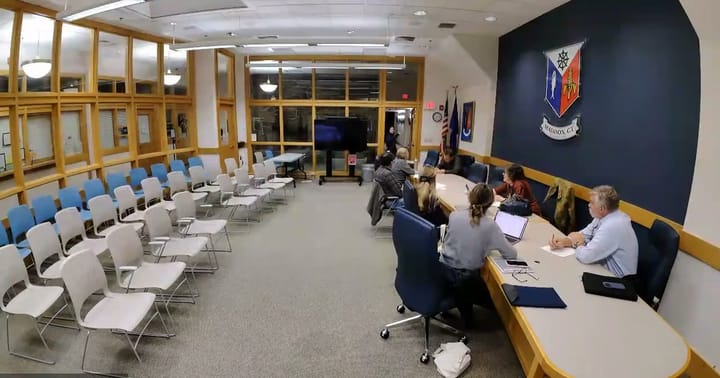
Conservation · Meeting of October 28, 2026
MADISON — The Madison Conservation Commission reviewed two bids for a natural resource inventory and weighed a possible rodenticide ban at its October 28 meeting. Two firms, Jim Nordgren and GZA, submitted qualification proposals by the deadline for the inventory, which carries a town-set budget of $40,000 to $50,000; interviews with both are planned for early-to-mid November. A member reported a severe Tree of Heaven and spotted lanternfly infestation discovered on a privately owned island, where roughly 100 of the invasive trees share habitat with a nesting bird rookery that could complicate removal.
Lisa Shirk, vice chair of the Newtown Conservation Commission, submitted written public comment urging Madison to adopt a municipal rodenticide ban like the one Newtown passed in April, saying "we are not against pest management, we just want them to use other tools in their toolbox." Members discussed inviting Shirk to present at the November 18 or December 16 meeting. No substantive votes were taken; minutes were approved unanimously.
In the full story:
- Call to Order and Minutes
- Natural Resource Inventory RFQ Update
- Outreach Events Debrief
- Summer Intern Projects
- Tree of Heaven and Spotted Lanternfly Management
- New High School Liaison
- CT Invasive Plant Symposium Report
- CACIWC Annual Meeting and Rodenticide Workshop
- Webpage and Handout Review
- Rodenticide Policy Public Comment
- Adjournment
- Who Was There
- Organizations And Documents Referenced
- The complete report: 2,774 words
Source: the Conservation meeting of October 28, 2026, reported from the official video recording and transcript.
Checked against the record: before publication this article was automatically compared with the meeting transcript.
The Full Article
Call to Order and Minutes
The commission opened at 7:40 p.m. after a brief delay caused by being locked out of the meeting room. Members approved the September 23, 2026 minutes without changes on a motion from a member identified as Richard, seconded by a member identified as Alex, by unanimous voice vote. No surnames for either member appear in the agenda, minutes, or transcript.
Natural Resource Inventory RFQ Update
Background and stakes: The commission put out a request for qualifications for a National Resource Inventory, a baseline ecological survey the commission has been pursuing as prior business. The question before the body was simply a status update, not a selection.
The question before the body: whether qualified firms had responded by the deadline and what the next procedural step should be.
Substantive content: Two firms responded by last Friday's deadline. One proposal came from Jim Nordgren. The other came from GZA, described in discussion as a firm whose principals include Donald Goldberg and a person whose surname was transcribed as "Zoyno" or "Zoyno," spellings the transcript itself was uncertain about. A member described GZA as a roughly 70-person firm based in Massachusetts with an extensive map of prior Connecticut shoreline projects, while Nordgren was described as a one-person operation based in Madison. A member said the town had set aside between $40,000 and $50,000 for the inventory, and that neither proposal yet carries a final price because the RFQ stage is meant to let the commission and the firms clarify scope, including what is meant by "tree survey," before fee numbers are attached. Members noted the commission is not obligated to hire either firm and could rebid the work if neither proposal fits.
The deliberation: Discussion centered on timing pressure rather than substance. One member noted "the sooner we get that figured out, the better because other people are after the planning funds," reflecting a concern about competition for town planning dollars rather than disagreement over the firms themselves.
Procedural steps and outcome: No vote was taken. Members agreed to schedule interviews with both firms, with November 9 or November 13 floated as the likely dates, and the materials will be circulated by email to the full commission.
Implications and what is next: The interview outcome will determine which firm, and at what cost, conducts Madison's natural resource inventory, a project that will shape future conservation and land-use decisions once complete.
Outreach Events Debrief
Background and stakes: The agenda called for a debrief of three fall public outreach events: the Bauer Park Festival, the Polson Community Fair volunteer expo, and the Mad for Trees sapling giveaway.
The question before the body: whether the events were effective and what to change going forward.
Substantive content: Members described the Bauer Park Festival as cold, with lower turnout than the prior year's warmer Sunday, but said a rodenticide-alternatives display and spotted lanternfly "smashing" demonstration drew interest. The Polson Community Fair was new for the commission this year; a member called turnout low but said there was "decent interest from both kids and parents," with conversations focused on light traps and spotted lanternfly rather than full rodenticide displays. At the Mad for Trees giveaway, a member reported fewer total visitors than at Bauer Park but more substantive conversations because attendees had already chosen to request a tree, and several recognized a member from online spotted lanternfly videos. One couple at the giveaway asked how to volunteer and was directed to the commission's website contact form.
The deliberation: Members agreed that reaching out directly to passersby, rather than waiting at a static table, produced better engagement, with one member crediting another, identified as Sophia, for teaching that approach. Members discussed whether more tables at additional locations, and partnering with the Tree Advisory Committee on future events, would expand reach.
Procedural steps and outcome: No vote was taken; this was a discussion item.
Implications and what is next: The commission intends to look for more off-site tabling opportunities and closer coordination with the Tree Advisory Committee for future outreach.
Summer Intern Projects
Background and stakes: The commission has pending deliverables from its 2026 summer interns that had not yet been incorporated into town materials.
Substantive content: A member reported receiving a completed report from an intern identified as Caroline, after an earlier draft had been mistakenly left in an email draft folder rather than sent. Separately, "dark sky" and light-pollution content prepared by an intern identified as Jane had been added to the town website under the "green home" section; members discussed pulling it out as its own topic because the existing placement required several clicks to find, and discussed working with Austin Hall to adapt the material for use at town beaches this summer.
Procedural steps and outcome: No vote was taken.
Implications and what is next: Members plan to review Caroline's full report before deciding how to publish it, and to develop beach signage drawn from the dark-sky material with Austin Hall.
Tree of Heaven and Spotted Lanternfly Management
Background and stakes: This item has been a recurring commission priority tied to invasive species management and a reported heavy 2026 spotted lanternfly season. It gained urgency after harbormaster Steve Atkins reported a severe infestation on a privately owned island in Long Island Sound, raising both an environmental concern, tied to a possible state-listed bird rookery, and a stated commercial concern near the Madison Beach Hotel.
The question before the body: how, and whether, the commission should pursue management of a Tree of Heaven stand and lanternfly population on private island property, and how to advocate for state-level training on invasive management.
Substantive content: A member identified as Fran described being contacted by Atkins after reports of thousands of lanternflies near the island, and organizing a site visit with two others identified as Bob and Kelly, a UConn Master Gardener. The group was dropped by boat and left on the island for roughly 90 minutes to survey conditions. Fran's resulting report, supplemented by observations from Bob, found an estimated 100 Tree of Heaven trees, some at least 50 years old, growing with minimal soil over bedrock, plus poison ivy, goldenrod, and English ivy. The island supports nesting egrets, gulls and terns, and a member said it may fall under a state Natural Diversity Database designation protecting breeding-bird habitat, which would restrict any plan to remove the trees outright. A grove of female Tree of Heaven trees, visible on satellite imagery on the island's east side, was identified as the primary seed source; members discussed girdling and herbicide treatment of those trees this fall as a way to cut off reproduction without removing the full stand, allowing standing dead trees to remain for bird use.
The deliberation: Members drew on lessons from the Connecticut Invasive Plant Working Group's symposium, held the same day, where practitioners described successful girdling-and-herbicide treatment of Tree of Heaven in shaded forest settings at two separate preserves, including one in Hampton where trees treated five years earlier had not regrown, though six previously undetected trees were later found by their lanternfly coverage. A member cautioned that cutting the trees down prematurely, rather than treating them in place, risks triggering root sprouts if the tree is not fully dead, and that correct timing, in fall when the tree is moving resources to its roots rather than in spring, matters for effective treatment. A separate concern raised was coordination with the state Department of Energy and Environmental Protection and Audubon before any removal, given the bird nesting activity.
Procedural steps and outcome: No vote was taken. The commission has permission from the property owner, a beach club, to assess the site but has not finalized a management plan. Fran indicated a report would be sent to Atkins outlining recommendations.
Implications and what is next: Any treatment this fall would target only the seed-producing female trees, pending further coordination with state wildlife officials; a full removal plan remains unresolved given the rookery designation.
New High School Liaison
Background and stakes: The agenda listed a welcome for a new high school liaison to the commission.
Substantive content: Mary Swec, introduced as a senior with an interest in biology, environmental biology, and marine biology, told the commission she is "very interested in biology and environmental biology, and especially marine biology." A member said the commission could identify interim coastline-related opportunities for her, particularly once the natural resource inventory gets underway.
Procedural steps and outcome: No vote was taken; this was an introduction.
Implications and what is next: Swec is expected to take on coastal- or marine-related tasks as the inventory project develops.
CT Invasive Plant Symposium Report
Background and stakes: A member attended the Connecticut Invasive Plant Working Group's Biennial Symposium the day of the meeting and reported back on relevant sessions.
Substantive content: The member said roughly 300 people attended statewide. Sessions covered a 22-acre bittersweet removal and salvage logging operation that brought in contractors to clear standing dead trees before controlled regrowth from an existing seed bed; a panel on invasive-plant management "myths" noting that propane torches are not an effective solution; a study of multi-year barberry removal by hand in an Avon watershed that recovered 11 species of spring ephemerals; and a session on porcelain berry, an invasive the commission has already found at Surf Club this summer. A separate talk argued that Connecticut has too few invasive-removal contractors, in part because municipalities and land trusts write unrealistic requests for proposals; the speaker recommended towns create a dedicated vegetation-management budget line, soliciting bids each November after Japanese knotweed season ends and awarding contracts by mid-December so crews can begin work in March.
The deliberation: Members discussed whether Madison should adopt that budget-line model, noting the town currently has roughly $70,000 allocated but said it is largely spent reactively "cleaning up after storms" rather than for proactive invasive management, and that the commission does not yet have a policy allowing the line item to be repurposed.
Procedural steps and outcome: No vote was taken.
Implications and what is next: Members indicated interest in raising a dedicated vegetation-management budget line during the town's next capital improvement planning cycle, but no proposal has been drafted.
CACIWC Annual Meeting and Rodenticide Workshop
The commission noted two upcoming outside events: the Connecticut Association of Conservation and Inland Wetlands Commissions annual meeting on November 14 in Cromwell, featuring keynote speaker Dave Skelly on amphibians and climate change, which the town will reimburse members to attend; and a rodenticide workshop on November 5 in Old Saybrook, sponsored by what members identified as a Connecticut River regional conservation district now operating from the DeKoven House in Middletown, which also publishes an "Invasive Plants in Your Backyard" guide. No vote was taken on either item.
Webpage and Handout Review
Background and stakes: The commission has an existing webpage of conservation handouts, some dating back roughly a decade to the commission's original interns, identified as Elizabeth, Sarah and Marina, that members said has never been fully curated since.
Substantive content: Members identified several gaps: a dead survey link reported twice by an out-of-state resident, a notable-trees survey form that no longer connects anywhere, and an "animals and insects" section that covers rat control but not mice, which members said are a more common homeowner concern. Members also discussed overlap with the Tree Advisory Committee's content and whether tree-related pages should link between the two committees' sites rather than duplicate material.
The deliberation: Members agreed the page needs a dedicated point person for technical maintenance and proposed each member take ownership of specific subject sections — one member volunteered to review the water section, another the trees section — reporting back with findings at the November meeting.
Procedural steps and outcome: No vote was taken. Members agreed to bring ranked section assignments to the November meeting.
Implications and what is next: A division-of-labor plan for the webpage overhaul is expected to be finalized at the commission's next meeting.
Rodenticide Policy Public Comment
Background and stakes: The commission received a written comment, read aloud because the sender could not be admitted to the Zoom webinar as a panelist, from Lisa Shirk, vice chair of the Newtown Conservation Commission.
The question before the body: whether to invite Shirk to formally present a proposed municipal rodenticide ordinance to the commission.
Substantive content: Shirk's statement said Newtown became the first Connecticut town, in April 2026, to adopt a municipal ban on second-generation anticoagulant rodenticides on town property, and that three additional towns have since passed similar measures, with roughly 30 towns having inquired. She said Connecticut restricted these rodenticides, commonly called "scars," to use by 257 licensed professionals as of 2025, but argued the chemical class itself, not the applicator, causes secondary poisoning of predators, pets and children. She cited Newtown's pest-control vendor shifting to "smart technology" monitoring in some buildings as an alternative. She offered to present to Madison's commission, as she said she did recently for Eastline (East Lyme) virtually.
"We are not against pest management. We just want them to use other tools in their toolbox so that our wildlife, our pets, and our children will be safe."Lisa Shirk, vice chair, Newtown Conservation Commission 01:15:22
The deliberation: Members expressed interest in inviting Shirk but wanted a written outline first of how Newtown's ordinance was passed before scheduling a presentation, noting budget season begins to dominate the agenda in January.
Procedural steps and outcome: No vote was taken. Members discussed scheduling Shirk for either the November 18 or December 16 meeting, pending her availability, and asked that materials be requested from her in advance.
Implications and what is next: Whether Madison considers its own rodenticide ordinance depends on this presentation being scheduled and on the commission's own review of Newtown's model, with no date yet confirmed.
Adjournment
Members adjourned on a motion and second, approved unanimously, with no names recorded for mover or seconder in the transcript.
WHO WAS THERE
- A presiding member ran the meeting and called votes; no title or surname for this person is confirmed in the agenda, minutes, or transcript.
- A member identified only as Richard, moved approval of the September minutes.
- A member identified only as Alex, seconded that motion.
- A member identified only as Amy, discussed CACIWC planning and the webpage water section.
- A member identified only as Fran, reported on the island Tree of Heaven and lanternfly survey.
- A member identified only as Al Gross, participated in outreach events and tree identification walks.
- Mary Swec, newly welcomed high school liaison.
- Two additional participants, identified only as Matthew and Michael Miller, were named as attendees joining the meeting; their roles were not specified in the transcript.
- Austin Hall, a town staff contact referenced regarding beach signage and a proposed Senior Center talk; no title confirmed in sources.
Public commenters:
- Lisa Shirk, vice chair of the Newtown Conservation Commission, submitted written public comment on municipal rodenticide policy; she was unable to join the meeting as a Zoom panelist to speak live.
Outside parties referenced but not present:
- Jim Nordgren, individual proposer for the Natural Resource Inventory RFQ.
- GZA, firm proposer for the Natural Resource Inventory RFQ.
- Steve Atkins, Madison harbormaster who initiated the island site visit.
- Dr. Gail Ridge, referenced as a Connecticut Agricultural Experiment Station (CASE) speaker available for spotted lanternfly talks.
ORGANIZATIONS AND DOCUMENTS REFERENCED
- GZA: Massachusetts-based environmental firm, one of two qualification proposers for the Natural Resource Inventory.
- Connecticut Department of Energy and Environmental Protection (DEEP): cited for pesticide-use rules allowing municipal employees and land trust members to apply general-use pesticides, and for its Natural Diversity Database designation potentially covering the island's bird rookery.
- Connecticut Agricultural Experiment Station (CASE): referenced as the source of Dr. Gail Ridge's spotted lanternfly presentation offer.
- Connecticut Advocates for Trees (CAT): hosting a December 7 legislative session where members plan to raise Tree of Heaven training with state legislators.
- Connecticut Invasive Plant Working Group: held the Biennial Symposium attended by a member the day of the meeting, source of multiple management case studies discussed.
- Connecticut Association of Conservation and Inland Wetlands Commissions (CACIWC): hosting its annual meeting November 14 in Cromwell.
- Connecticut River regional conservation district (operating from the DeKoven House, Middletown): sponsor of the November 5 rodenticide workshop and publisher of an "Invasive Plants in Your Backyard" guide cited in the webpage review.
- Newtown Conservation Commission: source of the rodenticide ordinance model discussed via Lisa Shirk's public comment.
- Audubon: referenced as a concerned party regarding bird nesting on the island.
Share this story
Know someone in Madison who follows town government? Share Townbrief Madison: they can sign up free.