Residents urge zoning moratorium during rewrite
Madison's Planning and Zoning Commission held a listening session where residents pressed for stormwater limits and a possible development moratorium ahead of a zoning rewrite.
Planning and Zoning · Meeting of October 1, 2026
Madison's Planning and Zoning Commission held a listening session where residents pressed for stormwater limits and a possible development moratorium ahead of a zoning rewrite. Consultant Michael D'Amato of Tyche Planning & Policy Group told the commission the update will consolidate regulations once split across four documents into one searchable online code and must incorporate a new state "middle housing" mandate requiring towns to allow two to nine units as of right on commercial lots, effective July 1. Resident Jim Nordgren said a moratorium would prevent "a flood of development applications trying to get in under the old regs," while Conservation Commission member Terry Vandendolder urged the board to treat the Plan of Conservation and Development as "your Bible." D'Amato warned Madison will soon be assigned a required housing-unit number by its regional council of government under a new state Housing Growth Plan law.
The commission's only vote was a 7-0-0 motion to adjourn at 7 p.m.
In the full story:
- Who Was There
- Organizations And Documents Referenced
- The complete report — 2,157 words
Source: the Planning and Zoning meeting of October 1, 2026, reported from the official video recording and transcript.
Checked against the record: before publication this article was automatically compared with the meeting transcript.
The Full Article
Overview: Launching the Zoning Regulations Rewrite
Madison's Planning and Zoning Commission convened a special listening session, the first in a series the agenda describes as designed to "guide the project and inform updates" to the town's zoning regulations. The session exists because the commission has undertaken a comprehensive rewrite of a regulatory code that consultant Michael D'Amato, of Tyche Planning & Policy Group, described as having become fragmented across four separate documents and appendices over decades of piecemeal amendment. The question before the commission that night was narrow: gather resident and business-owner input on priorities before staff and the consultant begin drafting section-by-section revisions.
Chair Carol Snow called the meeting to order at 6 p.m. in Meeting Room C, with attendees also joining by Zoom. She introduced D'Amato, who delivered a roughly 20-minute presentation before opening the floor to more than a dozen public speakers for the balance of the hour.
Zoning Regulations 101 and the Goals of the Project
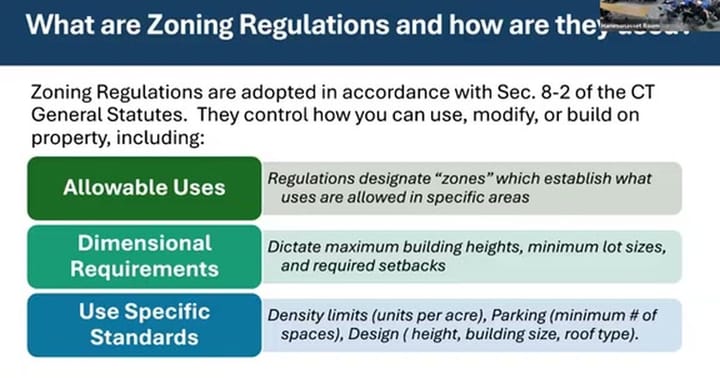
D'Amato walked through the legal basis for zoning in Connecticut: towns have had the option to adopt zoning regulations since 1923 under what is now Section 8-2 of the Connecticut General Statutes, and only two Connecticut municipalities have chosen not to. He explained that the Planning and Zoning Commission writes and adopts the regulations, while the separately required Zoning Board of Appeals handles variances and appeals.
He listed the project's core goals: ensuring compliance with state statute and case law, aligning the regulations with Madison's recently adopted Plan of Conservation and Development, consolidating the regulatory text into a single, codified online document through the General Code platform, simplifying language and adding graphics for lay readers, and incorporating modern tools for stormwater and environmental review. He named early priority topics already identified by staff and the commission: residential floor area, flood-zone building standards, accessory apartments and housing types generally, signage, commercial site design, stormwater and low-impact development, and coastal zone regulations.
"We want to make sure that we're really leveraging all of those best practices," D'Amato said, framing the update as an effort to avoid leaving Madison with outdated tools when development applications come before the commission.
[00:07:08] — Michael D'Amato, planning consultant
Consolidation, Codification and the Middle Housing Mandate
The reorganization work completed so far carries no new policy, D'Amato emphasized, only a new structure. The regulations, previously split across four books and appendices, are being combined into one digital code that will track every amendment going forward so residents and business owners can trace how a given provision has changed over time.
"If a business owner or property wants to know what was it previously, how did this affect me two years ago, we want to be able to answer that," D'Amato said, describing the "breadcrumb trail" built into the new General Code structure.
The one substantive change folded into that reorganization, per D'Amato, was the commission's adoption of "middle housing" form-based standards required by a 2025 special session act. The law requires towns to allow two to nine residential units as of right on any lot zoned for commercial or mixed use, effective July 1, 2026. D'Amato stressed the unit cap applies to the lot as a whole, not per building, and that commercial use is not required even on a commercial-zoned parcel. Because the law barred project-specific conditions through a public hearing process, he said the commission had to pre-adopt detailed design standards so it would not be caught administering the mandate with no implementing regulations in place.
Public Comment: Stormwater, Open Space and a Proposed Moratorium
Resident Jim Nordgren presented recommendations from a letter he had submitted to the commission, organized around three themes: reducing impervious surface on new development, expanding open-space set-asides in cluster developments, middle housing and planned development districts, and increasing the treatment of stormwater that is not retained on site. He tied each point to specific language in the Plan of Conservation and Development calling for strengthened zoning relative to stormwater and flooding, and to a state requirement that shoreline towns draining into Long Island Sound reduce nitrogen loading that causes hypoxia.
Nordgren pointed to beach closings in Fairfield County and chronic flooding on Westchester County parkways as evidence of what happens when impervious surface accumulates unchecked, and he projected those risks would worsen with sea-level rise he said is "already affecting the town of Madison." He proposed the commission consider a moratorium on new development applications while the regulatory overhaul is underway, arguing that major zoning rewrites typically trigger a rush of applications filed to beat new rules.
"It creates a flood of development applications trying to get in under the old regs," Nordgren said. "That's the purpose of a moratorium."
[00:26:52] — Jim Nordgren, resident
Paula Steere, who said she had reviewed the town's senior-citizen listening session materials from roughly two years earlier, said the current pace of development did not match the consensus that process had produced. She did not oppose growth outright but said regulations should avoid "pitting citizen against contractor" and should reflect that Madison lacks sewer infrastructure, relying instead on septic systems near Long Island Sound and inland waterways.
Public Comment: Conservation, Tree Protection and Wildlife
Amy Thomas, identifying herself as a member of the Conservation Commission, said that body had already submitted written input and planned to follow up with more specifics. She described the commission's mission as conserving natural resources "for all Madison residents" including plant and animal life, and cautioned that even a single tree represents an ecosystem.
Al Gross, chair of the Tree Advisory Committee, noted that his committee had submitted six written recommendations and said he was glad to see the commission beginning to act on them. Terry Vandendolder, who serves on both the Conservation Commission and Tree Advisory Committee, urged the commission to revisit the Plan of Conservation and Development regularly, calling it a document that should guide every application.
"I would hope that you would take each aspect of that POCD and maybe read that document once a month because in there is your Bible, so to speak," Vandendolder said.
[00:41:29] — Terry Vandendolder, Conservation Commission and Tree Advisory Committee
A resident who moved to Madison from California, identified in the meeting minutes as Dirk Vlieks, described a noticeable decline in local wildlife, including hawks and egrets she had previously observed, which she attributed to increased building activity. She said she had not affiliated with any organization but wanted the commission aware of the change.
Public Comment: Neighborhood Character, Permitting History and Trades
Sam Hauser, a lifelong Madison resident and business owner, asked the commission to review boat-storage restrictions in residential zones, describing a dispute with a neighbor over two boats, including a 13-foot Boston Whaler, parked in his driveway rather than in a side yard constrained by retaining walls and a stream.
Richard Talentino asked how an existing dense development on New Road, which he compared to a "Toll Brothers" project stripped of mature trees, had been permitted under current rules. D'Amato and staff explained the parcels were designated opportunity areas for planned development districts in the 2013 Plan of Conservation and Development, which allowed a prior commission to approve a developer's master plan through zoning amendments specific to those lots.
"That is an example of how the process works," D'Amato said, noting the commissioners who approved it are no longer serving but the underlying process mirrors what the current rewrite intends to formalize.
Jim Schmaltz, of Jonathan's Landing, reminded commissioners that as an appointed board with limited oversight, their decisions carry lasting consequences for the town's rural character. He cited declining construction quality in new housing and argued against zoning changes driven by shifting mandates from Hartford, saying funding and political priorities can change quickly.
Steve Ernest, of 5 Dover Lane, said he favors zoning that "limits, if not prevents, dense development" and opposes affordable-housing incentives that would allow circumventing other regulations.
Mary O'Connell, of 87 Mill Road, said she believed the southeast coastal section of Madison, citing the Windermere and Wellington developments and construction along Pottage Road, risks becoming overbuilt without a coordinated plan. She suggested the Economic Development Commission and Conservation Commission jointly craft a growth framework with environmental guardrails, and said residents given only six to eight weeks to respond to development applications often must hire outside engineers and lawyers, creating friction between residents, applicants and the commission.
D'Amato responded that the Plan of Conservation and Development, rather than a separate master plan, is intended to set that overarching framework, with zoning regulations serving as the enforceable mechanism beneath it. "All of those decisions have to be in alignment," he said, noting zone changes must be consistent with the Plan of Conservation and Development by statute.
The Coming Housing Growth Plan Mandate
D'Amato told the commission that Madison will soon be required to adopt a state-mandated Housing Growth Plan, under which the town's regional council of government will assign Madison a target number of housing units, with a methodology still being developed at the state level. He said the commission will then have to determine where that density is best accommodated.
"The opposite of density is sprawl," D'Amato said. "If we've got to put 100 units in town, if we keep things low density, it's going to require you to put those in a much greater area."
[00:56:40] — Michael D'Amato, planning consultant
Closing Comment: Scenario Planning and Heritage Sites
Alex Province, of 917 Boston Post Road, asked whether D'Amato's firm could provide scenario-planning software to show residents what Madison would look like in 25 or 50 years under current regulations versus proposed changes. He also urged the consultant to draft language precise enough to limit subjective interpretation by future commissions, and asked that heritage and cultural sites be mapped and protected alongside ecological corridors. He endorsed the moratorium idea raised earlier by Nordgren.
Procedural Outcome
No vote was taken on any zoning-policy matter. The commission's only formal action was a motion by Commissioner Mike Bugda, seconded by Vice Chair John Dusza, to adjourn at 7 p.m., which carried unanimously, 7-0-0, according to the minutes.
Implications and What Is Next
D'Amato said the next phase is a legal and best-practices compliance review to flag regulations that conflict with current statute or case law, followed by section-by-section drafting with additional public outreach on specific topics. No hearing dates have been set. Residents can continue submitting input through a project email address, zoningregs@madisonct.org, and a dedicated page on the town website.
WHO WAS THERE
Carol Snow, Chair, presided over the meeting. John Dusza, Vice Chair, present; seconded the adjournment motion. John Morgan, Secretary, present. Janet Peckinpaugh, member, present. Bob O'Connor, member, present. Michelle Clark, alternate, present per minutes. Mike Bugda, member, present; moved to adjourn. Alex Brody, member, present per minutes. Max Corroon, member, absent. Jeff Downes, member, absent. Erin Mannix, Town Planner, staff, present. Maria Pettola, Land Use Official, staff, present. Michael D'Amato, planning consultant with Tyche Planning & Policy Group, presented and fielded questions.
Public commenters: Jim Nordgren, resident, submitted letter on stormwater and open space; Paula Steere, resident; Sam Hauser, Madison resident and business owner, raised boat-storage question; Amy Thomas, resident and Conservation Commission member; Mary O'Connell, resident of 87 Mill Road; Al Gross, Tree Advisory Committee chair; Terry Vandendolder, Conservation Commission and Tree Advisory Committee member; Dirk Vlieks, resident, raised wildlife concerns; Richard Talentino, resident of Fairfield Road; Jim Schmaltz, resident of Jonathan's Landing; Steve Ernest, resident of 5 Dover Lane, via Zoom; Alex Province, resident of 917 Boston Post Road, via Zoom.
ORGANIZATIONS AND DOCUMENTS REFERENCED
Tyche Planning & Policy Group — consulting firm retained by the commission to lead the zoning regulations update; represented by Michael D'Amato. General Code — online codification platform the town is using to host the consolidated, searchable zoning regulations. Madison Conservation Commission — cited repeatedly by public commenters (Amy Thomas, Terry Vandendolder) as having submitted written input on environmental priorities. Madison Tree Advisory Committee — submitted six written recommendations referenced by chair Al Gross and member Terry Vandendolder. Madison Economic Development Commission — proposed by resident Mary O'Connell as a partner with the Conservation Commission on a coordinated growth framework. Plan of Conservation and Development (POCD) — Madison's guiding ten-year planning document, cited throughout as the framework the zoning rewrite must align with, including its 2013 designation of New Road parcels as planned development district opportunity areas. Connecticut General Statutes Section 8-2 — cited by D'Amato as the state statutory authority under which towns adopt zoning regulations. 2025 Special Session Public Act on middle housing — cited by D'Amato as the state mandate requiring towns to allow two to nine residential units as of right on commercial or mixed-use lots, effective July 1, 2026. Regional council of government — will assign Madison its required housing unit allocation under the forthcoming state Housing Growth Plan mandate.
Share this story
Know someone in Madison who follows town government? Share Townbrief Madison: they can sign up free.